

Accessibility in public transport
Passengers with disabilities should be able to use public transport independently. The FOT supports transport companies in implementing the legal requirements.
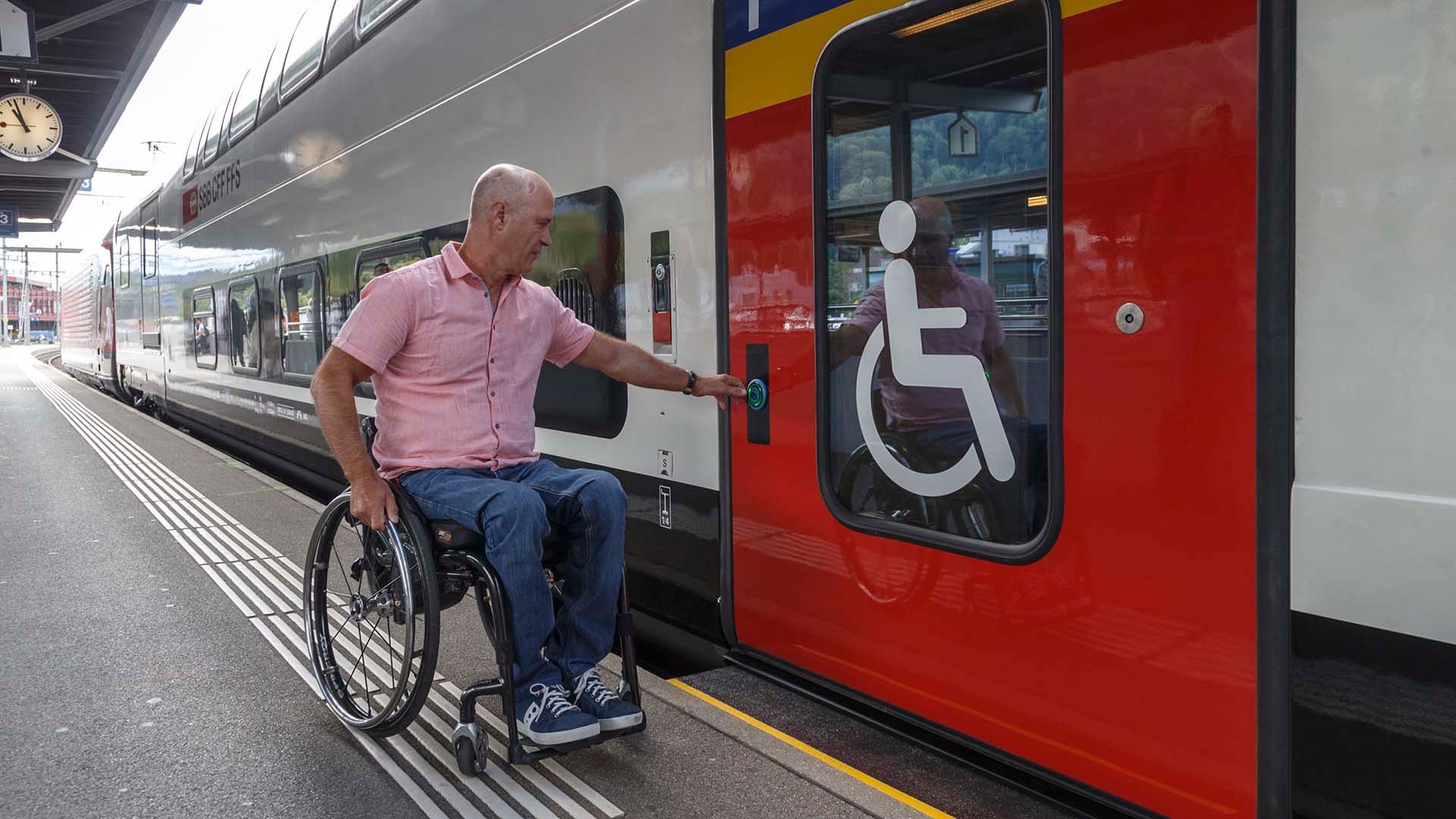
The Disability Discrimination Act (DDA) stipulates that public transport must be barrier-free and in general allow passengers with disabilities to use it autonomously. These statutory measures benefit other passengers too.
The transport companies and infrastructure operators are responsible for implementing the measures, while the cantons and communes are responsible for bus stops.
In recent years, great progress has been made in installing disabled-friendly information and ticketing systems, procuring low-floor vehicles, raising platforms and building additional ramps and lifts. Priority was given to major railway stations in these works. However, by the legal deadline of the end of 2023, the transport companies had not managed to complete the modifications at around 500 of the 1,800 stations and stops. For these, transport companies must provide interim measures (assistance from railway staff or, if necessary, a shuttle service) until the stations can be used independently by people with disabilities.
The FOT supports companies in implementing the DDA. Where there are delays to adapting stations, the FOT requires transport companies to submit time schedules and budgets to avoid any further delay to implementation. The FOT provides funding and ensures a standardised technical implementation by issuing guidelines and checklists.
Further Information
Legal regulations
Equality for people with disabilities and impairments is enshrined in the Federal Constitution and the Disability Discrimination Act.
Studies on standards development
The FOT has commissioned several studies that provide the information required for the adaptation of public transport for people with reduced mobility.
Federal Office of Transport FOT
Mühlestrasse 6
3063 Ittigen